Mary's Room
Updated: Nov 19, 2021
⚝──⭒─⭑─⭒──⚝
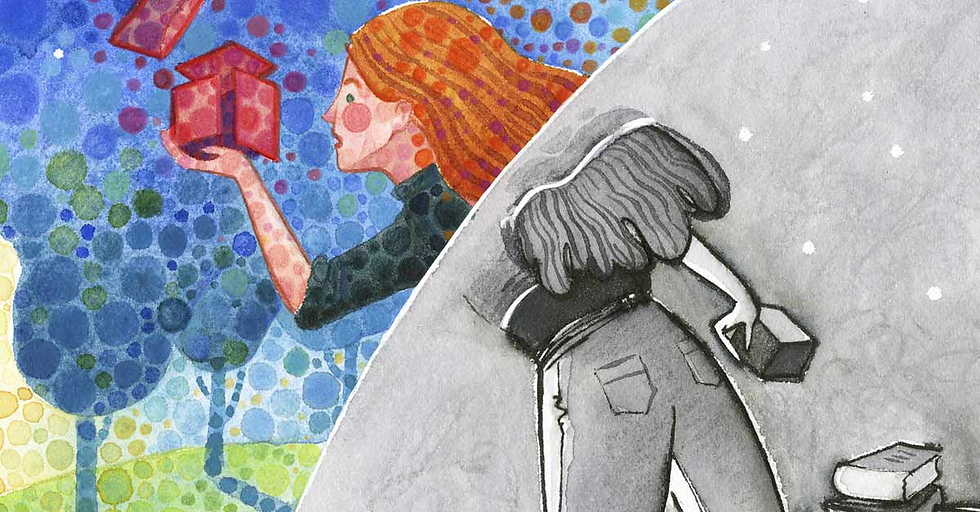
Okay. For those who don't know, "Mary's Room" is a thought experiment on whether a lot of knowledge of something can ever replace the experince itself. In this case, it's about colour. Obviously this thought experiment is more than that. (I found that wikipedia explains it quite well, so I will link that.)
I am pretty sure this particular aspect of "Mary's Room" has already been debunked but I wanted to write it my way. (Examples of rebuttals)
Here are some basic things you should know about it:
wikipedia page (yes, please read everything here)
Yes I am really lame, I read wikipedia for fun, but it's so informative though.

So I assume you have watched the short video. This video was released in 2017. So like, I don't know if anyone knows this, but you know how they say animals are colourblind and all? What if they're just able to experience colours we cannot see. It's pretty much a fact that most wavelengths of light are not visible to the human eye, and that we see only a fraction of it really (taken from my highschool physics textbook). Right, so like no matter how much we study said unseen colours, we aren't going to see it any time soon, unless we mutate or something. Like seriously, lobsters can see more colours than us, but do the scientists who work on this know what colours those lobsters can see? (source and source) (Found in 2018.) (Also, a note that though they can see more colours than us, they cannot really differentiate it)
Anyway, I am clearly slapping physicalism in the face. (Is this a scientific approach? No, not at all. Please don't insult theories or arguments you do not like.) Like, try describing colour to a blind person (blind since birth). You're pretty much just describing how those colours make you feel (which is not at all objective) instead of explaining how the colour looks like.
That's it on me with my hatred for physicalism (I am just kidding, I don't actually hate it).
Now we come to the most important part of all. What can we learn from this?
Well since theory isn't very practical, I say you should take this as a sign to go out and experience the world more (with covid in mind of course). I think knowledge is never complete without experience. I have read so much snow, but I have never experienced it. Can you say I actually know snow?
So does this whole thing fall into science or philosophy? Both obviously. I feel like a lot of things can never really be fully understood but we can always continue trying.
Additional reading material:
Physicalism
Functionalism
Qualia
"What Is It Like to Be a Bat?"
Explanatory gap
Chinese room

Honestly I wanted to make this more detailed, but bearing in mind that no one reads this, I decided that the fact I read so much while trying to write something is the achievement itself. (And the fact that I made this blog to kind of track what I get obsessed with.)
That's it for now.
-Lemon Farmer
∧__∧
(´・ω・)
/ ⌒ヽ
(人__つ_つ


Comments